Service Accelerator · Metadata Management

Build a semantic layer for pharma data without hand-labeling every column

Clovertex’s metadata management accelerator helps teams turn hundreds of input files with thousands of columns into a usable, governed semantic layer. When the same raw field name like status appears across regulatory, clinical, pharmacogenomics, and demographic datasets, the agent uses ontology, source context, and sample data to infer the right business meaning and route uncertain mappings to a human reviewer.

  • Normalize repeated source columns into canonical business terms for downstream analytics and applications
  • Score each mapping with confidence so teams know what can auto-publish and what needs review
  • Preserve category, sub-category, source lineage, and privacy flags while publishing a business-ready semantic layer
100s

Input files feeding metadata-management workflows across downstream applications

1000s

Columns that must be labeled correctly before research and analysis can move faster

1 name

A single raw field like “status” can represent multiple business concepts depending on source and ontology

Human-in-loop

Low-confidence or regulated mappings are routed for approval instead of silently guessed

The business problem

Metadata management becomes recurring manual work when the same labels show up everywhere but mean different things. That ambiguity slows semantic modeling, makes downstream applications harder to trust, and turns simple analysis into a long curation exercise.

Why generic column names break pharma analytics

  • The same raw column name can appear in regulatory, clinical, pharmacogenomics, and demographic sources
  • Teams lose time deciding whether “status” means FDA clearance, trial recruitment, metabolizer phenotype, or something else
  • Without a consistent semantic layer, downstream analytics inherit inconsistent business definitions
What that looks like operationally

  • Metadata work becomes recurring activity instead of a reusable governed asset
  • Research and analysis slow down because labels must be interpreted file by file
  • Shared business concepts are rebuilt repeatedly across pipelines, teams, and applications

Create the semantic layer once, reuse it everywhere

The agent does more than rename columns. It identifies the business concept behind each source field, aligns it to ontology-backed canonical terms, and publishes a reusable layer that downstream teams can trust.

Context-aware interpretation

The agent evaluates source schema, neighboring columns, source system, and sample values so it can distinguish one “status” from another instead of treating them as identical labels.

Ontology-backed canonicalization

Mappings are anchored to canonical names, business categories, and sub-categories so regulatory, clinical, and biomarker concepts stay separate but interoperable.

Governed approval workflow

Each decision carries confidence and workflow state. High-confidence mappings can advance quickly, while ambiguous or sensitive fields are held for reviewer approval.

What the semantic layer stores

  • Raw source column name and original data source
  • Human-readable business label for downstream users
  • Canonical term for consistent integration across systems
  • Category and sub-category for search, lineage, and governance
  • Confidence score and workflow status for review and publication

Why this matters in pharma

  • Regulatory data should not be confused with clinical operations or patient demographics
  • Privacy-sensitive mappings can be flagged early when PII-like concepts are detected
  • Downstream dashboards, research workflows, and AI agents all inherit cleaner business context

How it works

A four-step workflow turns messy source metadata into a publishable semantic layer with traceability and review controls.

1

Ingest

Read source schemas, column names, sample values, and file-level context from many incoming datasets.

2

Interpret

Use ontology terms, domain rules, and observed data patterns to infer the most likely business meaning of each field.

3

Score

Assign canonical labels, category, sub-category, source lineage, and a confidence score for each proposed mapping.

4

Approve & publish

Route uncertain or sensitive mappings to a human-in-the-loop, then publish a reusable semantic layer for downstream use.

Real-world semantic mapping example

The same raw field name can map to different business meanings depending on data source and domain. That is exactly the type of ambiguity this accelerator is designed to resolve.

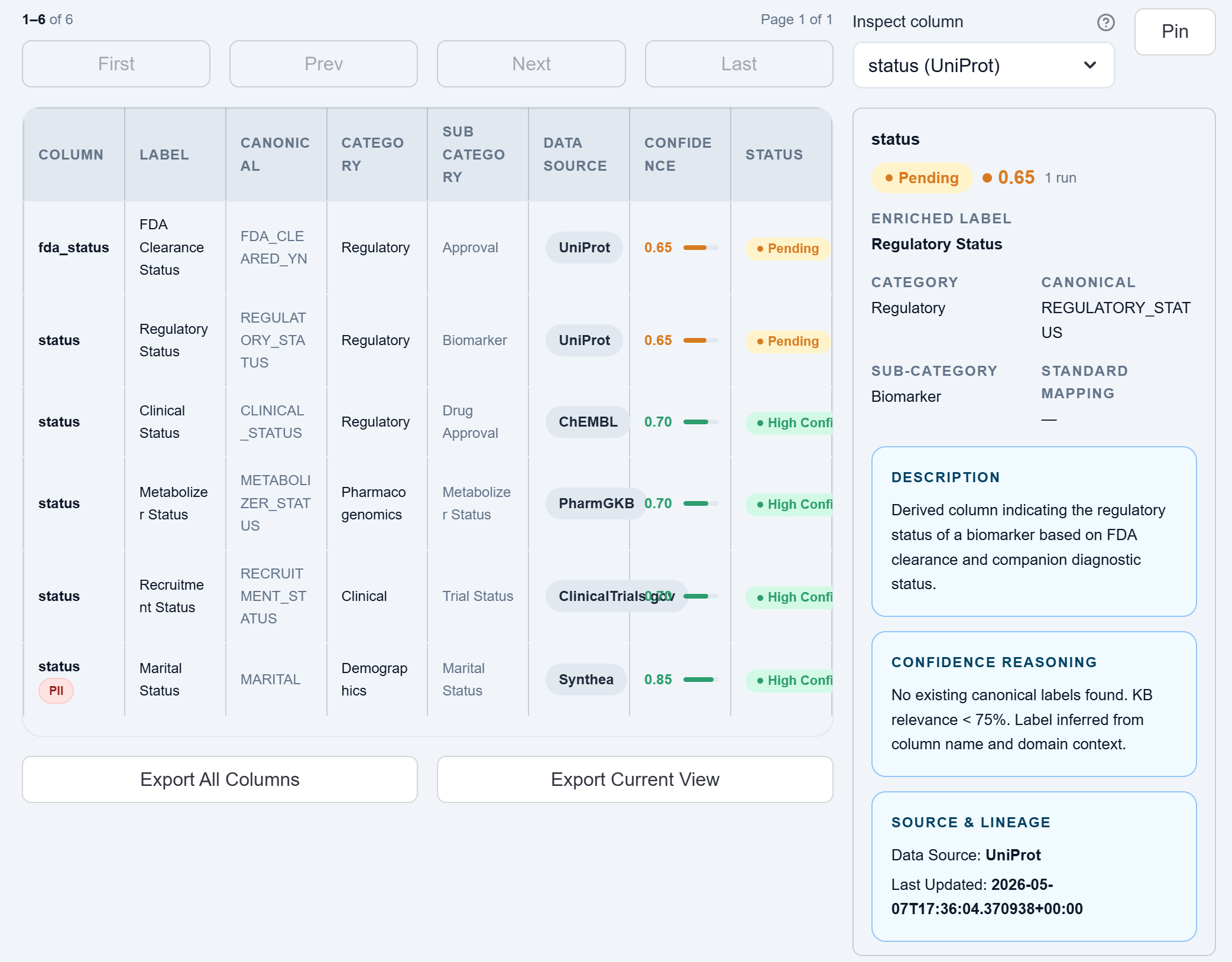
Metadata status mapping example with confidence scores and reviewer panel

Reference interface

A SaaS-style review experience shows the raw column, business label, canonical term, source, confidence, and workflow status in one place so curators can approve mappings quickly.

Column Label Canonical Category Sub-category Source Confidence Status
fda_status FDA Clearance Status FDA_CLEARED_YN Regulatory Approval UniProt
0.65
Pending
status Regulatory Status REGULATORY_STATUS Regulatory Biomarker UniProt
0.65
Pending
status Clinical Status CLINICAL_STATUS Regulatory Drug Approval ChEMBL
0.70
High Confidence
status Metabolizer Status METABOLIZER_STATUS Pharmacogenomics Metabolizer Status PharmGKB
0.70
High Confidence
status Recruitment Status RECRUITMENT_STATUS Clinical Trial Status ClinicalTrials.gov
0.70
High Confidence
status
PII
Marital Status MARITAL Demographics Marital Status Synthea
0.85
High Confidence

What this example proves

The agent is not just matching words. It is distinguishing multiple semantic meanings for the same raw field name, tracking confidence, and showing where governance review is required before that meaning is published downstream.

Business impact

A reliable semantic layer reduces recurring metadata work and gives downstream systems a cleaner business vocabulary to work with.

Speed

Faster analysis and research

Researchers spend less time decoding source fields and more time working with trusted business concepts.

Governance

Better semantic consistency

Regulatory, clinical, biomarker, and demographic concepts stay distinct even when sources reuse the same raw labels.

Scale

Reusable downstream metadata

Dashboards, applications, and AI workflows can all consume the same approved semantic layer instead of rebuilding definitions repeatedly.

Product screens from the metadata workflow.

These views show data-source quality, human review, and enrichment summary outputs from the metadata enrichment agent.

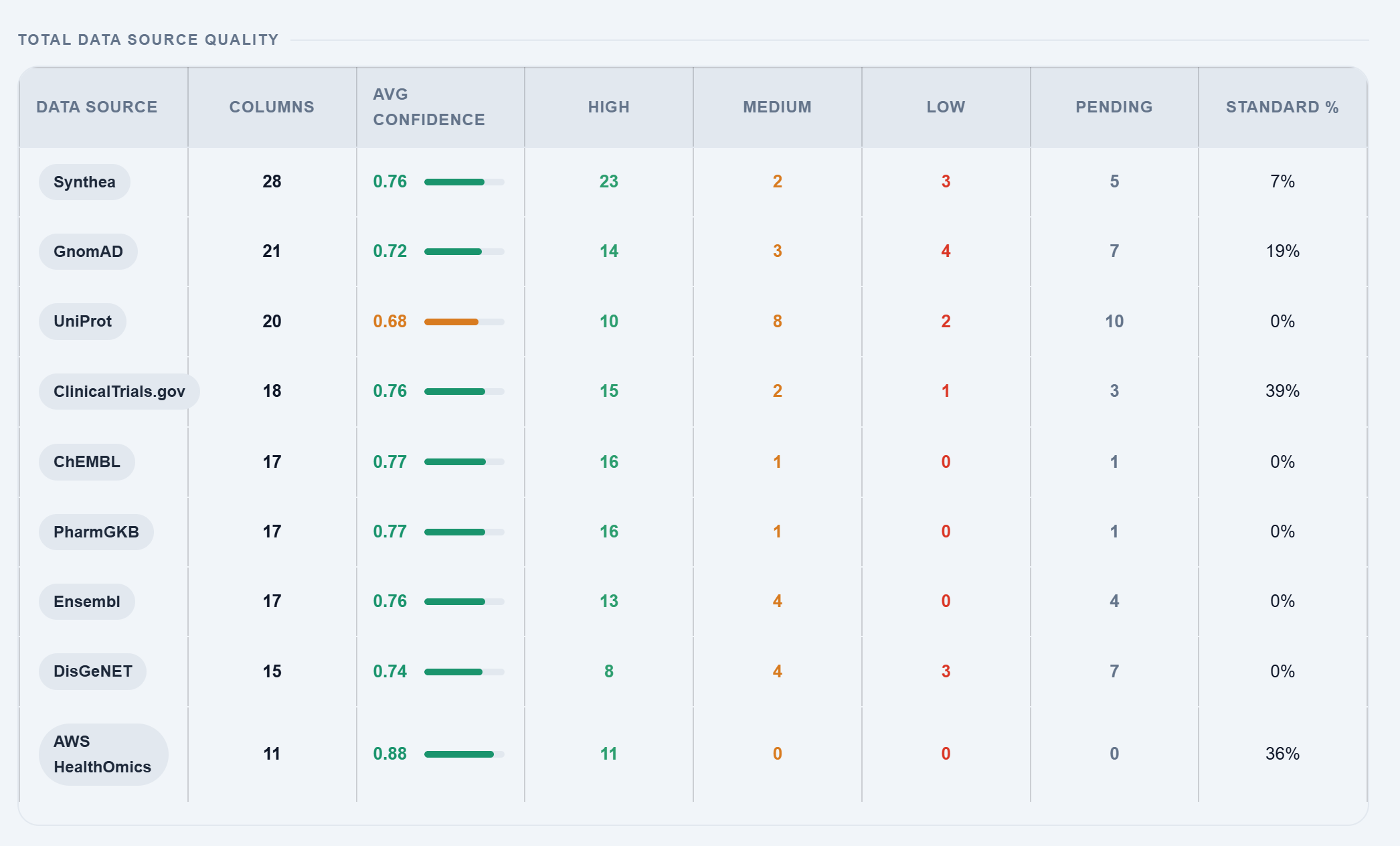
Metadata data source quality table

Data source quality

Compare confidence, pending review, and standardization signals by source.

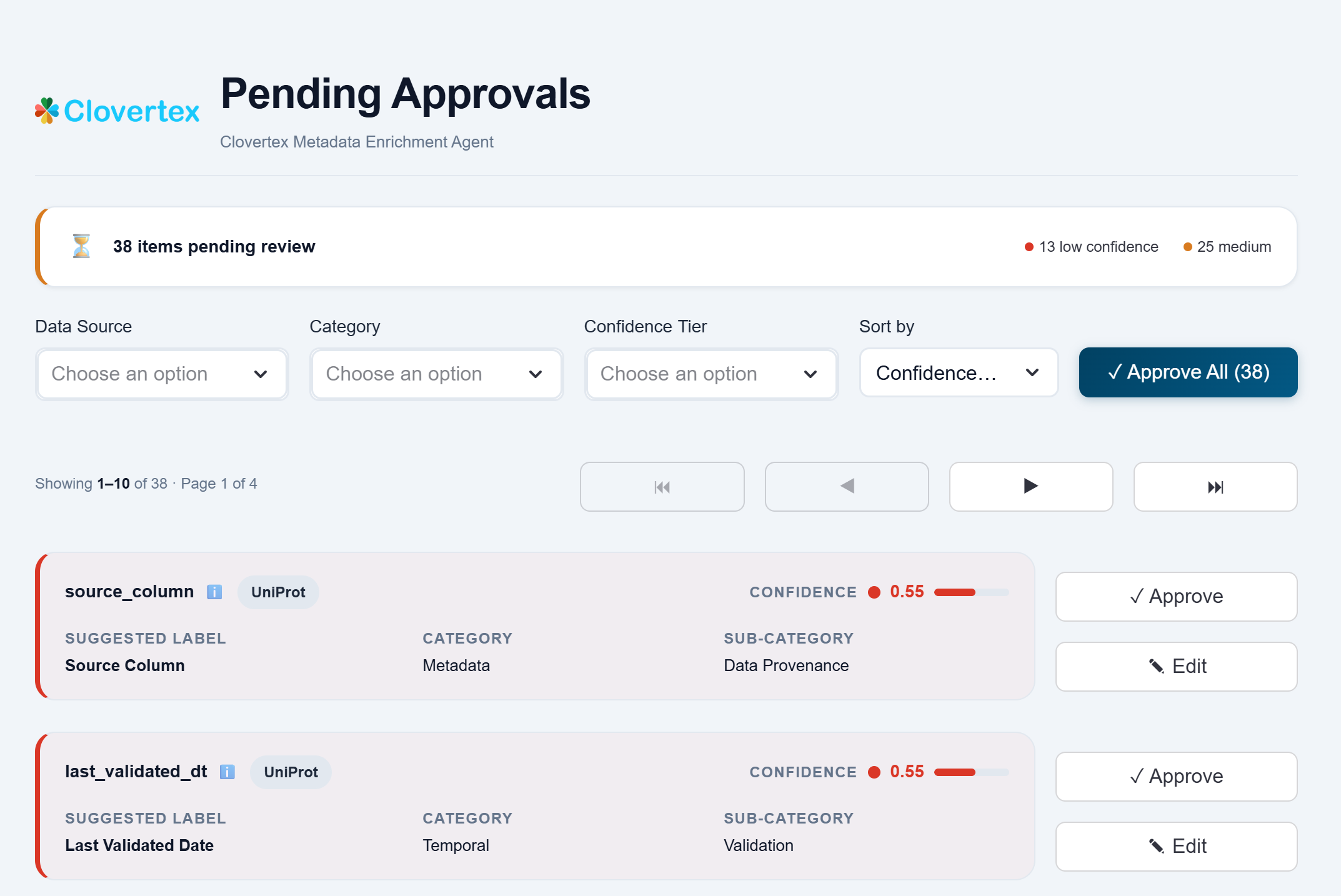
Metadata pending approvals human review queue

Human-in-the-loop approval

Route low-confidence metadata labels to reviewers before publishing.

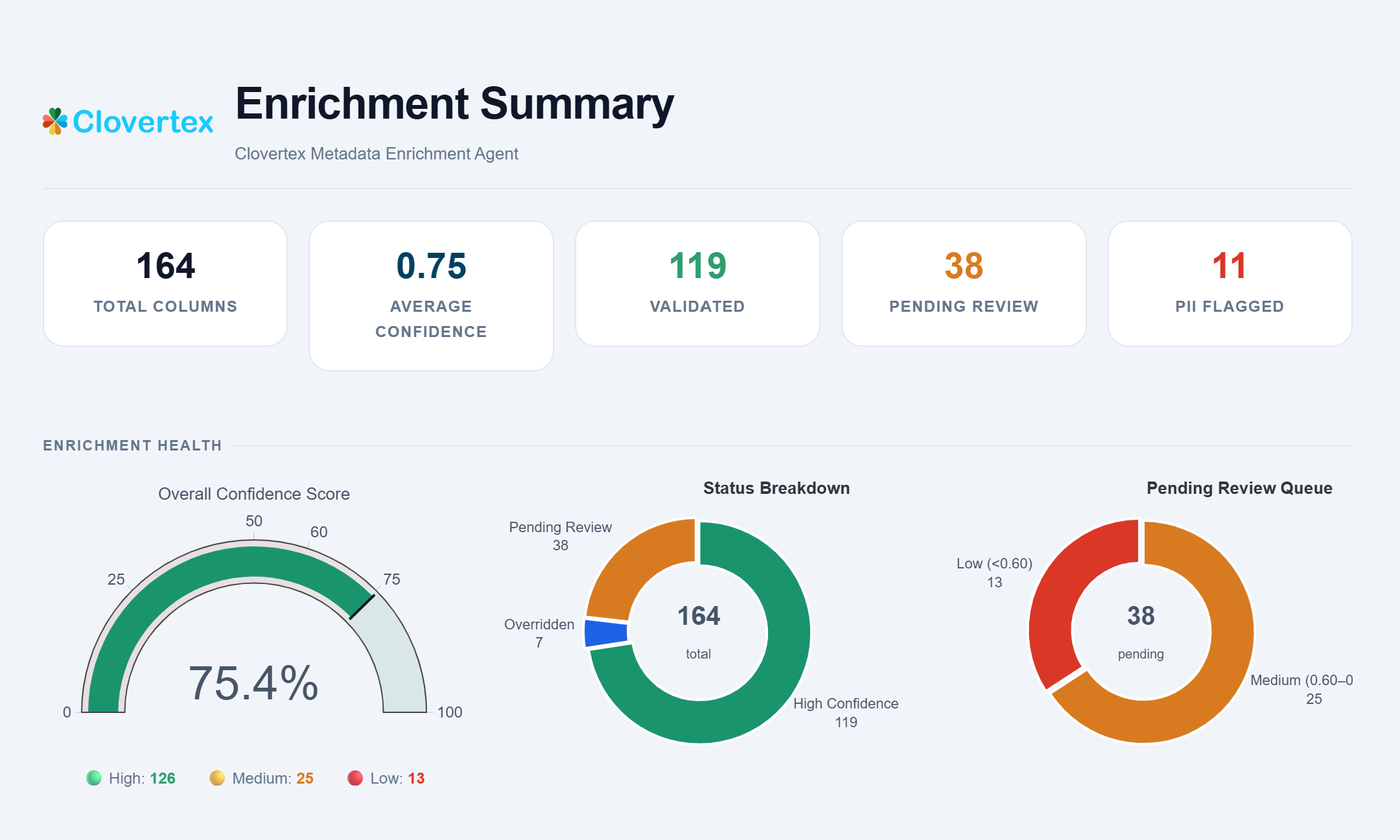
Metadata enrichment summary dashboard

Enrichment summary

Summarize validation, pending review, confidence, and PII flags.

Build a governed semantic layer for life sciences data.

Clovertex helps teams normalize repeated column names, preserve source lineage, score confidence, flag sensitive metadata, and route uncertain mappings to human reviewers before publishing downstream definitions.

Use cases include regulatory status, metabolizer status, recruitment status, demographic metadata, confidence scoring, pending review, high-confidence mappings, and human-in-the-loop approval.