Cost overrun associated with genomics-to-cloud migration failures
Service Accelerator — Genomics
Transform genomics workflows into cloud-ready pipelines.
Clovertex helps teams assess workflow readiness, plan controlled migration, and improve observability when moving genomics workflows to AWS and HealthOmics.
- Assesses HPC workflows for migration readiness
- Identifies gaps, risks, and migration difficulty: easy, moderate, or hard
- Supports common workflow languages such as WDL, Snake make, CWL, NextFlow, and scripts
Time delay from manual, unpredictable migration effort
Readiness classifier used to organize migration difficulty and risk
Readiness assessor, migration agent, observability agent, and human-in-the-loop oversight
The problem
Genomics-to-cloud migration failures cost time, money, and credibility.
Bioinformatics workflows are often tightly coupled to local environments with hardcoded paths, inconsistent structures, and poorly defined inputs and outputs, making them difficult to migrate and scale.
Tightly coupled workflow environments
Workflows depend on local assumptions, hardcoded paths, and inconsistent structures that break when moved into cloud execution environments.
- Hardcoded paths
- Inconsistent structures
- Poorly defined I/O
No standard readiness model
The deck highlights the lack of a standardized readiness assessment for migration feasibility, forcing teams into manual evaluation and higher failure rates.
- No standardized readiness assessment
- Manual effort and unpredictable timelines
- Delayed cloud adoption increases cost and operational risk
What it does
A workflow assessment and migration model for AWS and HealthOmics.
The PowerPoint describes an AWS HealthOmics Assessment Agent focused on readiness assessment, issue discovery, code-level visibility, and controlled migration execution for genomics workflows.
Surface gaps, risks, and migration difficulty
The solution evaluates HPC workflows for migration readiness and classifies them by difficulty so teams can plan effort more clearly.
- Assesses migration readiness
- Identifies gaps and risks
- Classifies difficulty: easy, moderate, hard
Show what needs change before migration begins
The deck says the system can highlight code lines that need change and support controlled migration execution rather than relying on opaque manual debugging.
- Highlights code lines that need change
- Supports common workflow languages
- Supports controlled migration execution
How it works
Four layers of assessment, migration, and oversight.
The service model follows four stages: Readiness Assessor, Migration Agent, Observability Agent, and Human-in-the-loop review.
1
Readiness Assessor
Evaluates workflows and identifies migration gaps and risks before cloud execution starts.
2
Migration Agent*
Executes controlled, reliable migration with minimal manual effort.
* In development3
Observability Agent*
Monitors runs and provides clear insight into performance and failures.
* In development4
Human-in-the-loop
Keeps oversight at every stage so migration remains controlled and reviewable.
Product views
Representative interface views from the attached PowerPoint.
These product views show workflow submission, assessment scoring, and issue-level compatibility review in a larger walkthrough format so each screen is readable.
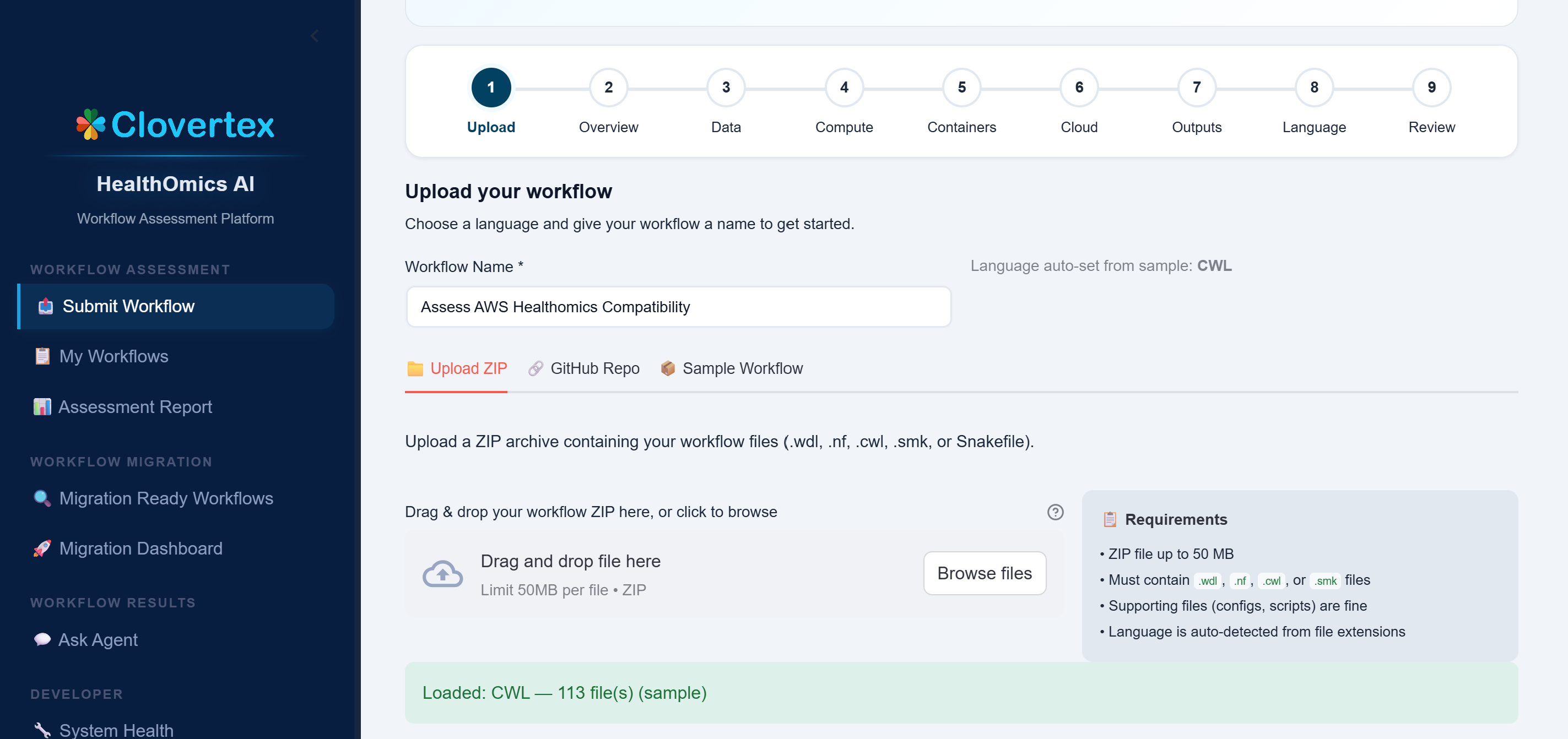
Submit workflows for migration review
This product screen shows workflow submission with language selection, upload options, and a guided multi-step intake flow.
Assess readiness across categories
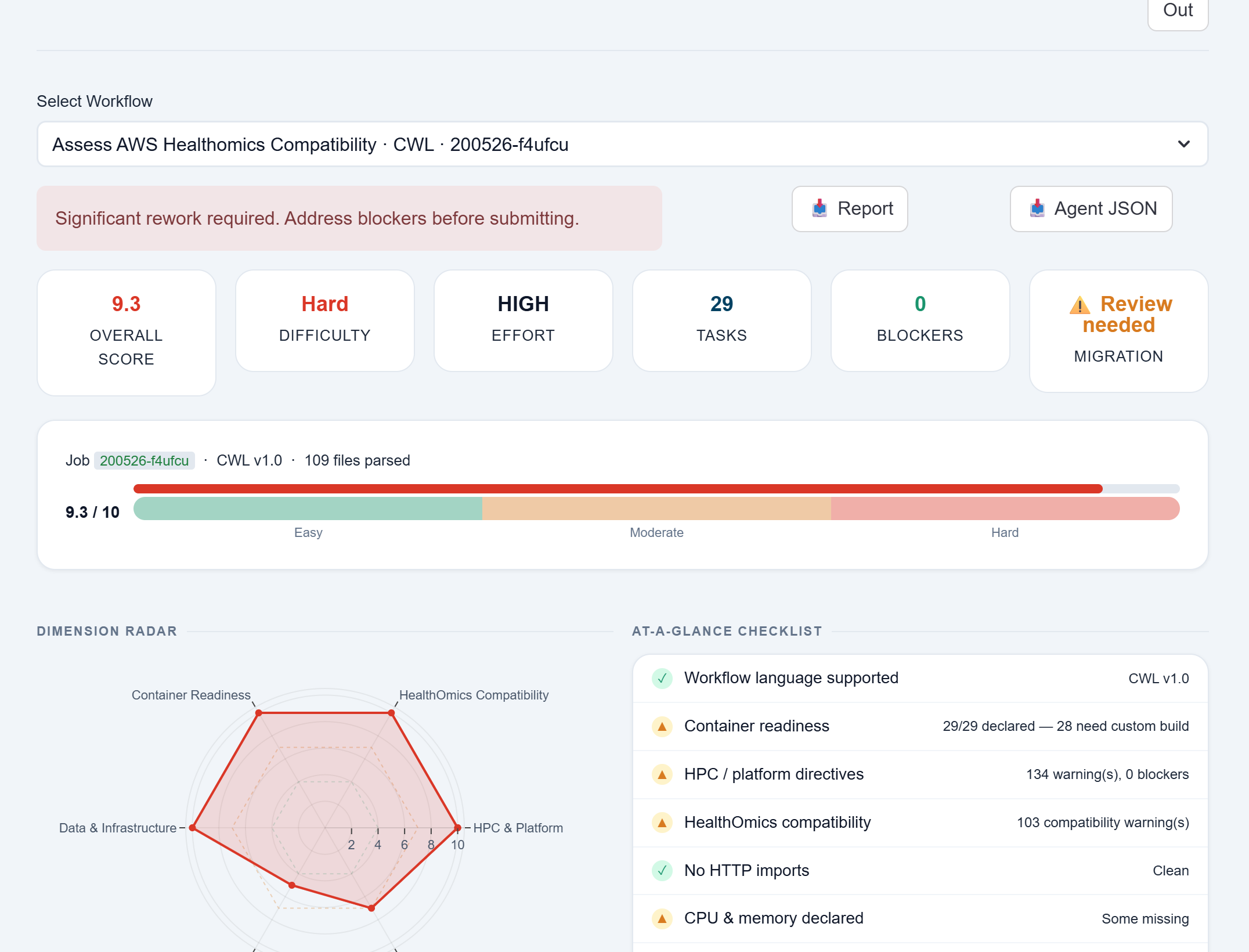
The scoring view groups workflow migration findings into categories such as platform compatibility, containers, data, and workflow structure.
Inspect blockers and compatibility issues
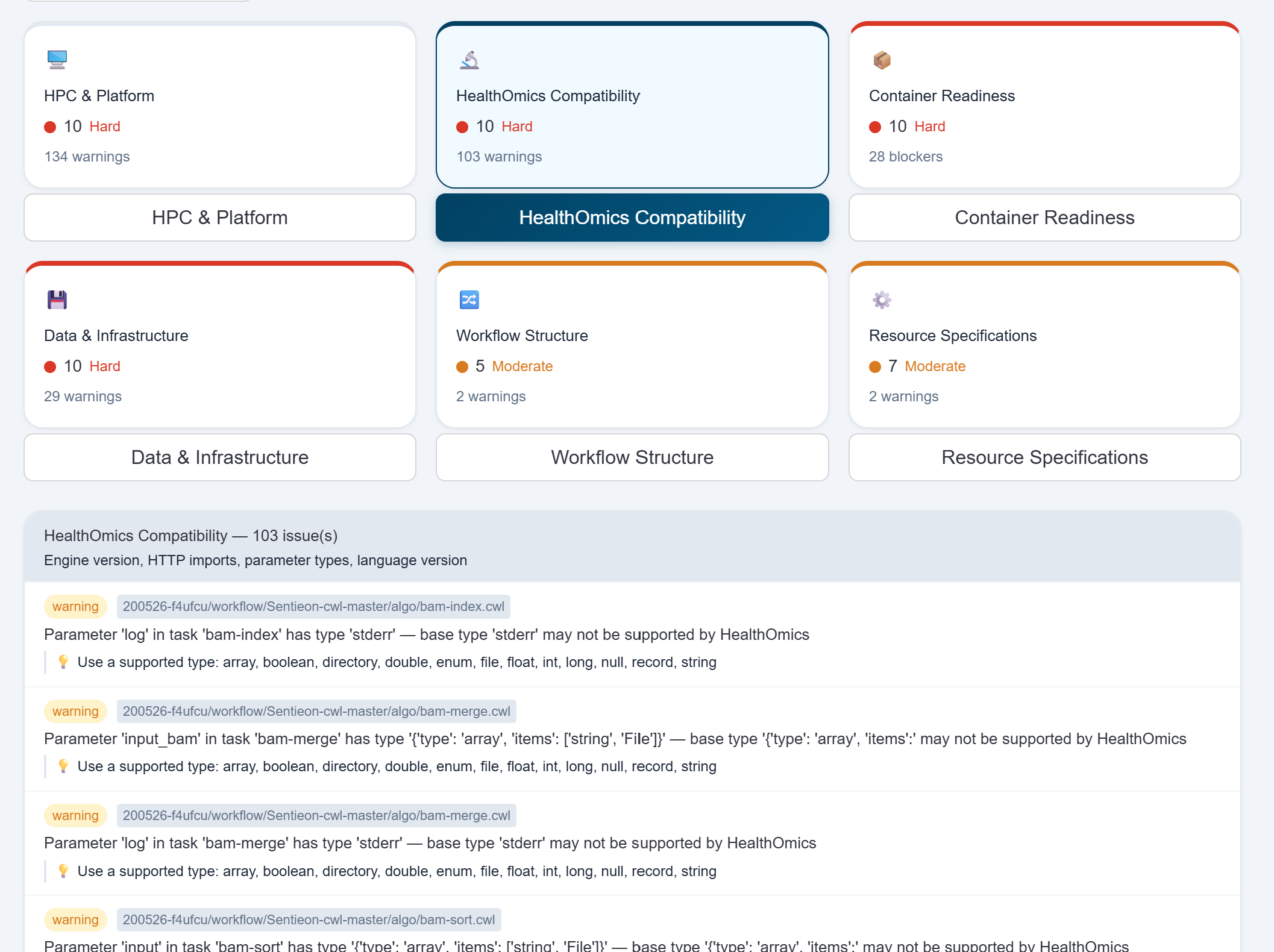
The detailed issue view supports code-level remediation by showing blockers, file references, and compatibility guidance.
Business impact
Lower migration cost, lower delay, higher success, and better resource efficiency.
These four outcomes summarize the business impact of a structured genomics migration service accelerator.
Migration cost
Less manual rework and better upfront readiness insight aim to reduce cost overrun.
Time to migration
Structured assessment and controlled execution aim to shorten the time required to move workflows.
Success rate
Teams get clearer visibility into feasibility and blockers before migration effort compounds.
Efficiency
Automation, observability, and human review support more efficient use of specialized migration resources.
Representative numbers
From local genomics workflows to cloud-ready pipelines.
The presentation frames this as an AWS HealthOmics assessment and migration accelerator designed to help teams avoid costly failure patterns and move with more confidence.